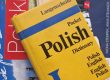
Imagine you’re about to do a walking tour of Warsaw and you’re feeling the history and culture around you.
You meet your local tour guide and he’s wearing a name tag with this on it:
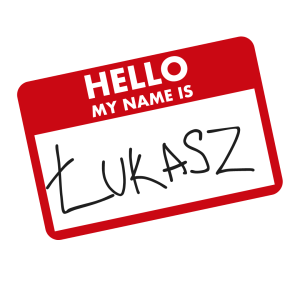
Is that an L or a small t?
Sz? sss then zzz?
Your trip through Poland doesn’t require learning the Polish language.
However, if you’re willing to put in a bit of effort and learn how to pronounce common Polish names, you’re going to make tour guides, cashiers and locals incredibly happy when you pronounce their name even a little bit correctly!
You might even learn a little about tradition.
Some might find it hard to understand the unique Polish letters, but others are drawn in. For people like that, Polish surnames are the next step!
This article will help you figure out how to pronounce common names by teaching you a little about common Polish sounds.
The Challenge of Difficult Polish Names
The Polish alphabet has special letters that might be tough for English speakers.
For example, let’s examine our tour guide Łukasz: the “Ł” sounds like “W,” not “L.” The “sz” is equivalent to the English “sh.”
So Łukasz is pronounced “woo-kash’.
Names like Agnieszka (Ag-nyesh-ka) and Grzegorz (Grzeg-orsh) are common in Polish culture.
But Polish has sounds that are not found in English, making it hard to say. It’s ranked as the 10th toughest language for English speakers.
Names like Konrad and Ola are easy for Anglophones. Some names are the same in English and Polish.
Robert, Anna, Daniel, Adam, Julia (Although it’s pronounced “you-lia“)

Names like Jędrzej (Yen-dzay) and Małgorzata (Maw-gor-rza-ta) aren’t as easy.
Cracking the Code: The Polish Alphabet Explained
The Polish alphabet is key to learning Polish. It has unique traits that are important for correct pronunciation.
Letters like ‘Ą’ and ‘Ć’ are more than just marks.
There’s a big difference between Cześć (the informal ‘hello’) and część (a part of something).
| Character | Pronunciation Guide | Remark |
|---|---|---|
| Ą | own | Nasal sound |
| Ć | ch as in church | Softened ‘ch’ sound |
| Ł | w | Similar to ‘w’ in ‘will’ |
| Ś | sh | Sharpened ‘sh’ sound |
| Ź / Ż | zh | Resembles ‘s’ in ‘vision’ |
Knowing the basics of the Polish alphabet is a big step in learning Polish. It makes understanding culture and language easier.
For those starting to learn Polish, knowing these sounds makes it easier. It turns hard parts into successes. So, learning the Polish alphabet is a must for anyone serious about Polish.
How to Pronounce Polish Names
Learning how to say Polish names right makes talking with native speakers better – even if you’re speaking in English.
It shows respect and helps avoid mistakes.
Many people struggle with Polish pronunciation. Saying ‘ł’ as ‘l’ instead of ‘w’ is a common error.
Note: Making a mistake when you try to speak Polish isn’t going to offend a Pole. Truth be told, they’ll be ecstatic that you’re trying.
Breaking down syllables helps with pronunciation.
Polish vowels always sound the same, which helps with learning.
| Special Character | Description | Example in Usage (Polish Word) |
|---|---|---|
| ł | Pronounced like ‘w’ in English | Łowicz |
| ą | Nasal sound similar to ‘on’ in French | Książka |
| ś | Sh sound as in ‘sheet’ | Ślusarski |
| ż/ŕ | Similar to French ‘j’ in ‘jour’ | Żuraw |
| ć | Softer ‘tch’ sound | Cześć |
Syllable stress
Once you think you’ve got the sounds down pat, the next step is stressing the right syllable.
Stress on the wrong syllables in words can make things harder. Stressing the right syllable helps take your Polish pronunciation to the next level.
In Polish, the stress is almost always placed on a word’s penultimate (second-to-last) syllable, making it crucial for clear and accurate pronunciation.
This rule applies consistently across most words, including names.
For example, the name “Kowalski” emphasises the “wal” syllable: Ko-wal-ski. Similarly, in the name “Nowak,” the stress falls on the “no” syllable: No-wak.
Putting it all together
Pronouncing Polish last names can be straightforward with a bit of practice and understanding.
Let’s break down the most famous Polish surname.

Recognising patterns aid pronunciation. Familiarity with Polish sounds, especially consonant clusters and vowel combinations, is crucial.
“Czy” and “cz” are arguably the same sound, the equivalent to the English “ch’ sound as you saw earlier
The letters ‘ie’ make an ‘ee-eh’ sound in Polish, and is often seen with a consonant in front. Nie, Kie, Bie. When you know this sound, it’s easier to pronounce words like Niemcy, Kiełbasa and Biegac.
Then we start to see Polish characters like ą and ę mixed in with letters like rz, sz and ść. For example, rzę sounds like ‘zewn’, szą is like ‘shown’ and ęść comes out like ‘escht’.
Suddenly, piecing it all together simplifies the initially overwhelming “Brzęczyszczykiewicz”.
Brzę-czy-szczy-kie-wicz.
Bzewn-chish-che-kev-itch.
Remember to stress the second-last syllable.
Bzewn-chi-sh-chi-KEV-itch.
Practice with names like “Nowak” (NOH-vahk) and “Kowalski” (koh-VAHL-ski) to master the typical stress on the penultimate syllable.
Nicknames
Getting Polish first names right means understanding their sounds. Names like Agnieszka and Zbigniew have unique sounds. Polish has complex consonant clusters and nasal sounds that make names like Łukasz or Grażyna special.
But if you’re struggling, most Poles have no issues being referred to as their nicknames.
For example, Krzysztof becomes Kris, and Magdalena is often called Magda.
| Original Name | Nickname or Abbreviation | Phonetic Insight |
|---|---|---|
| Aleksander | Olek | Reduction to first syllable with diminutive suffix |
| Barbara | Basia | Common switch to ‘ia’ ending for femininity |
| Elżbieta | Ela | Shortening to two syllables for ease |
| Stanisław | Staś or Staszek | Diminutive form, affectionate use |
| Bartosz | Bartek | Diminutive, adding ‘-ek’ after shortening |
| Małgorzata | Gosia | Diminutive form, but removing the first syllable |
| Michał | Michael | Anglification of a Polish name |
It’s important to note that there’s a difference between a nickname or diminutive in Polish and anglicising a Polish name. Our tour guide Łukasz doesn’t really name a nickname in Polish.
But the English version Lucas, and often abbreviated to Luke. Check first before you refer to a Łukasz as Luke, or a Grzegorz as Greg.
It’s a bit weird and somewhat rude to refer to this guy as Fred:

Conclusion
Learning Polish names is a big task that covers simple and complex aspects. It includes learning a phonetic alphabet and understanding how gender affects grammar. By doing this, people not only get better at language but also show respect for Polish culture.
It’s not just about knowing words. You also need to get used to Polish sounds like the six pure vowels and tricky consonant clusters.
Learning Polish names teaches you about history, culture, and how people communicate. If you learn and respect these aspects, Poland takes on a whole new meaning to you!
And always remember:

FAQ
What are some common mispronunciations of Polish names and how can they be avoided?
Many people get Polish names wrong by thinking ‘W’ sounds like ‘V’ or ‘Cz’ sounds like ‘Kz’. Learn the right sounds of Polish letters like ‘Ł’ (sounds like ‘w’), ‘W’ (sounds like ‘v’), and ‘Cz’ (sounds like ‘ch’ in ‘church’).
How can understanding the cultural significance of Polish names enhance pronunciation?
Knowing the history and meaning of Polish names helps you connect with them. This makes you more careful and respectful when saying them. It leads to better pronunciation.
What unique characteristics of the Polish alphabet pose pronunciation challenges for English speakers?
Polish has letters like ‘Ł’, ‘Ń’, ‘Ś’, and marks that change sounds. These sounds are not in English and need practice to get right.
Can you provide a step-by-step guide on how to tackle the pronunciation of difficult Polish syllables?
Break the name into parts, then say each part using Polish rules. Pay attention to ‘nasal’ vowels (ę, ą) and consonant groups (sz, cz, rz). Listening to native speakers helps a lot.
Why are Polish names so long and what linguistic patterns explain this?
Polish names often have many consonants together. This shows historical and linguistic patterns. Names end with ‘-ski’, ‘-wicz’, or ‘-zyn’ to show where they’re from or who they belong to. This makes them long and complex.
How do variations in Polish last names affect their pronunciation?
Polish surnames can show if someone is a man or woman, or if they’re married. For example, ‘-ski’ is for men, ‘-ska’ for women, and ‘-cki’ for smaller versions. Knowing this helps with how to say them.
What are some popular Polish surnames to practice with to improve pronunciation?
Try saying names like Kowalski, Nowak, and Wiśniewski. They help you get used to sounds like ‘w’ as ‘v’, and the ‘ski’ ending as ‘skee’.
Are there any interactive resources that can help with Polish pronunciation?
Yes, there are many resources like apps, websites, YouTube channels, and audio dictionaries. They offer real pronunciation from native speakers.
What should be considered when analysing the phonetic components of Polish first names?
Focus on how to say vowels and consonants, where the stress goes, and how letters change sounds together. Understanding these can make you much better at saying Polish names.
How does understanding nicknames and abbreviations aid in pronouncing Polish names?
Nicknames and short forms make Polish names easier to say. They show how people talk informally. Knowing them can also teach you about Polish naming traditions.